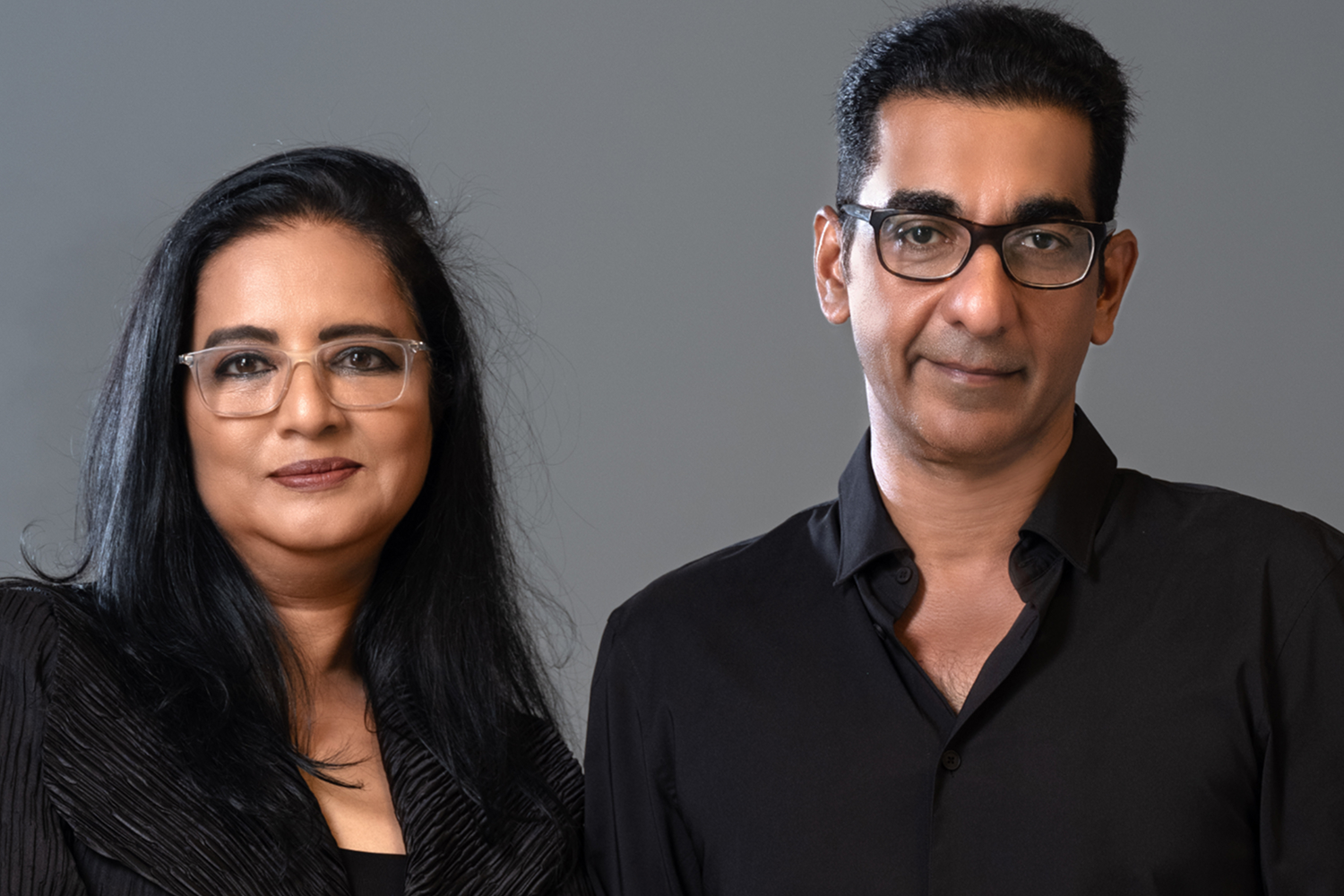
Sonali Rastogi and Manit Rastogi
Founding Partners, Morphogenesis
India

Partners in life and in practice, Sonali and Manit Rastogi established Morphogenesis in New Delhi in 1996, and this year mark 30 years of a studio guided by its S.O.U.L. approach, sustainability, optimisation, uniqueness and liveability. Sonali brings a passion for culture and urbanism, while Manit’s interest lies in nature and sustainability, the dialogue between their perspectives producing a productive creative tension.
Both studied architecture in New Delhi before independently finding their way to the Architectural Association in London, where Sonali explored deconstructivism and Manit discovered sustainable environmental design, then in its infancy. They returned to India together, married, and founded Morphogenesis, a name reflecting their intent to practice differently, morpho meaning to change smoothly, and genesis, the origin of something new.
Over three decades, sustainability has remained the throughline of their work, treated not as an aspiration but as a frugal necessity shaped by India’s diverse climates. With offices now in New Delhi, Mumbai, Pune and Bengaluru, Morphogenesis has built a portfolio spanning master planning, smart cities, residential, hospitality, commercial, institutional and landscape design across India, Bhutan, South Africa, Nepal, Bangladesh, the UAE, Sri Lanka and Afghanistan.
Among their most celebrated projects is the Surat Diamond Bourse, the world’s largest office building and a 2023 World Architecture Festival winner, alongside the International Tech Park Chennai, India’s first business park certified net-zero for energy, water and waste. Jaipur’s Pearl Academy made Morphogenesis the first Indian practice to win a WAF award in 2009, while the off-grid Lodsi Community Project won a category award at the Architecture MasterPrize in 2023.
Manit and Sonali are the only Indian laureates to receive the Getz Award from the Singapore Institute of Architects, and Morphogenesis is consistently ranked among the world’s top 100 architectural practices.
Now in 2026, the studio comprises nine practice areas, five offices and around 300 architects, more than half of them women. Having led Morphogenesis “”from the front”” for three decades, the Rastogis are now turning toward mentoring the next generation, ensuring the practice’s standing as a global force continues.
Through their work, Sonali and Manit Rastogi continue to shape the face of sustainable design, not only in India but across the architecture and design communities worldwide, shining lights for sustainability as Luminaries of the 2026 INDE.Awards.
Photography: Edmund Sumner
